Attention Needed: Fraudulent Permit Fee Scams Target Property Owners
A worrisome trend in property fraud is emerging, as scammers impersonate city and county planning departments to collect fictitious permit fees from unsuspecting property owners. This sophisticated scheme involves sending deceptive invoices under the guise of real municipal communications, pressuring victims to wire money quickly. The tactics employed by these fraudsters reveal the alarming lengths to which they go to exploit unsuspecting individuals, demonstrating a critical challenge in our increasingly digital society.
Escalating Fraud Tactics
On March 9, 2026, the FBI's Internet Crime Complaint Center issued a public alert regarding this alarming trend, highlighting how criminals exploit publicly accessible permit records to identify targets with active applications. What might seem like an isolated issue is actually indicative of a broader pattern. Scammers have figured out how to pinpoint specific individuals involved in legitimate municipal processes, allowing them to maximize their chances of success. Once they have their victims identified, these fraudsters send emails that appear legitimate, demanding payment through wire transfers, peer-to-peer services, or cryptocurrency.
According to the FBI’s 2025 Internet Crime Report, government impersonation scams are among the fastest-growing crime categories, with losses climbing nearly 100% year over year, totaling approximately $798 million. This rapid increase should raise alarms. It signals not just a rise in victims, but also an alarming shift in criminals' techniques, reflecting both their desperation and ingenuity in navigating the complexities of modern technology.
The Flaw in Fraud Detection
The deceptive nature of this scheme poses significant challenges for fraud detection systems. Notably, the payments are authorized by the victim. Traditional behavioral checks designed to spot anomalies fall short here. These systems are primarily programmed to flag suspicious behavior associated with account takeovers rather than genuinely misguided transactions. The complexity increases when one considers the psychological element at play; victims believe they're acting lawfully, making it even harder for algorithms designed to prevent crime to identify these scenarios as risks.
In this context, the true risk signal isn't rooted in the sender's actions but rather in the recipient accounts—the "money mule" accounts where funds are ultimately directed. This destination-centric approach can help differentiate between legitimate transactions and scams. However, existing detection systems often struggle to adapt to such nuanced fraud techniques. If you’re in the tech industry, you know that combating this kind of fraud demands both innovative detection methods and an informed public.
A Breakdown of the Scam
Understanding the typical flow of this fraudulent scheme is vital for prevention. Based on insights from the FBI alert and research by CYBERA, here’s how the process typically unfolds:
- Target Selection: Scammers scour public records for property owners with active planning or zoning applications.
- Impersonation: They craft emails posing as local planning officials, citing genuine permit and property details to gain trust.
- Invoice Generation: An official-looking invoice for processing or approval fees is sent to the victim.
- Creating Urgency: Scammers impose a tight deadline for payment, warning that failure to comply could jeopardize the application.
- Payment Confirmation: Victims are then asked to send proof of payment to confirm that the funds were received.
This systematic approach highlights a worrying trend in the mechanics of fraud. While it's easy to dismiss these scams as the doings of low-level crooks, they are actually intricately designed operations that rely on psychology and the expedited nature of certain transactions to exploit their targets. By creating an artificial sense of urgency and trust, scammers manipulate their victims' behavior in a way that feels very real and often leads to financial loss.
Understanding Mule Accounts
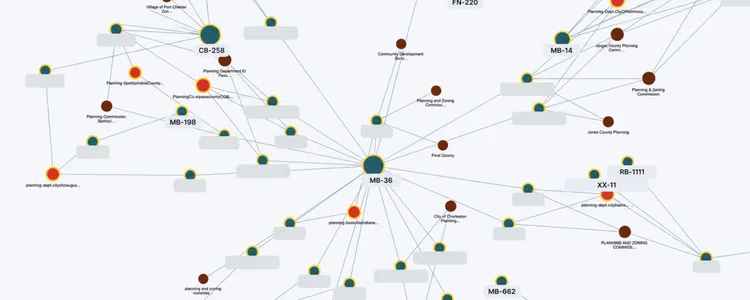
Insights from CYBERA’s research into a specific operation since September 2025, dubbed "Diligent Planner," reveal crucial information about mule accounts. Instead of relying solely on risk estimations, analysts engage directly with the scam’s operations to gather verifiable account details that criminals use for transactions. This hands-on approach stands in stark contrast to typical preventive measures; it effectively uncovers the underlying networks that facilitate this fraud.
This method uncovered 53 confirmed mule accounts dispersed across 23 distinct email campaigns, with approximately 55% of these accounts located in just two beneficiary banks. By obtaining confirmed accounts directly, rather than guessing based on probabilistic models, it becomes easier to formulate an effective response against these scams. The level of detail gathered underscores a vital shift in how we think about combating fraud—knowledge is power, especially when it comes to canceling these networks' operational capabilities.
Implications and Future Outlook
The ramifications of these fraud schemes are far-reaching, impacting not just individual victims but also eroding public trust in municipal systems. As more people become aware of scams that exploit their civic obligations, a sense of skepticism may grow towards legitimate communications from the government. This normalization of mistrust can have significant implications for public compliance with zoning laws and city planning regulations.
Looking ahead, the evolution of fraud tactics will likely continue. As technology advances, so too will the methods employed by these criminals. This signals a pressing need for municipalities to enhance their cybersecurity measures, not just for protection but also to educate constituents about how to discern genuine municipal communications from scams. If you’re working in this space, staying ahead of these trends will be essential. Because without proactive measures, the cycle of fraud and victimization is likely to persist, impacting more unsuspecting property owners and further straining our already beleaguered trust in governmental institutions.


