Reimagining Security Architecture in AI: The Shift to Platform Engineering 2.0
Over the past decade, security frameworks have heavily focused on human actors and conventional coding practices, developing a variety of controls like shift-left methodologies to detect vulnerabilities early and adopting zero trust to minimize risks. However, the landscape has shifted dramatically, leaving behind enterprises that were once structured around human coders and operators.
AI technologies are rapidly transitioning from experimental phases to crucial operational roles. These AI agents are autonomous, interacting directly with APIs and making decisions without any human intervention. The implications of this evolution mean that existing security strategies are ill-equipped to handle the new risk landscape, specifically when it comes to real-time inference streams and model registries.
Identifying Gaps in Current Tooling
The inadequacy of traditional security tools in the context of AI workloads is striking. Key vulnerabilities have emerged that standard SAST or DAST tools fail to address:
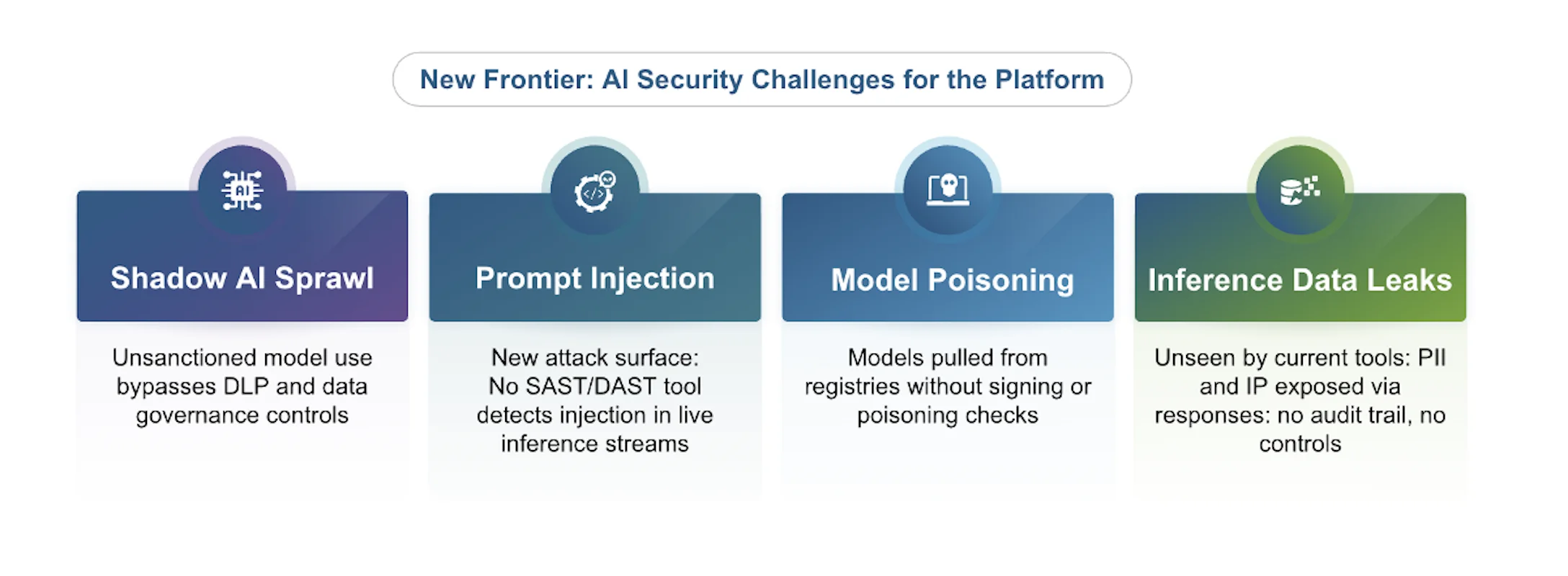
- Prompt injection: Malicious inputs can hijack live inference streams, yet existing tools are designed for static code vulnerabilities, rendering them ineffective.
- Model poisoning: Without proper signing or provenance checks, models taken from registries pose significant risks, akin to unsigned software artifacts.
- Inference data leaks: Personal and proprietary information can be compromised through model outputs without any audits, escaping detection by conventional DLP tools that monitor network layers.
- Shadow AI sprawl: Unregulated AI models are proliferating within organizations, bypassing established data governance measures.
These threats are not just potential scenarios; they are actively being exploited in companies that haven't modernized their security frameworks to accommodate AI technologies.
Broadcom
Architectural Changes: Ensuring Security through Platform Engineering 2.0
New challenges call for an architectural rather than procedural response. Traditional training and auditing cannot effectively resolve issues like prompt injections or model poisoning. Instead, the focus must shift to the platform as the primary security boundary.
Platform Engineering 2.0 offers a framework that provides four critical control points for securing AI and data privacy:
- Model governance: A structured model registry with version control, provenance tracking, and continuous monitoring ensures no model is deployed without proper validation.
- Prompt security: Implementing platform-wide input sanitization and output filtering protects against injection attacks at the infrastructure level.
- Data isolation and privacy: Enforcing strict tenant-level data boundaries, alongside encryption and DLP measures directly in inference pipelines, is essential for safeguarding sensitive information.
- Inference audit: Continuous audit trails for AI inference actions provide real-time oversight and compliance reporting, capturing both human and AI decision-making processes.
These elements establish the platform as the core security boundary, embedding robust security measures within the infrastructure without relying on developers to manage them proactively.
Addressing New Identity Issues with AI Agents
The rise of AI introduces a distinct identity challenge: the emergence of non-human identities navigating the enterprise landscape. These agents require precise permissions, credential management, and financial controls. Effective governance must include:
- MCP-compatible APIs for identifying agents.
- Policy frameworks limiting agent actions to predetermined patterns.
- Audit logs documenting all decisions, ensuring transparency and accountability.
- Escalation processes for uncertain outcomes needing human intervention.
If your identity management approach doesn’t consider these agent identities, there’s a growing risk that could result in significant security gaps as organizations scale these deployments.
Implications for Chief Security Officers
The evolving identity of AI agents places increasing security complexities beyond the developer's scope. Traditional controls that assumed only human engagement in systems are faltering as agents autonomously interact with sensitive data pipelines and make decisions.
The effectiveness of security measures tied to AI deployments now hinges on the maturity of platform engineering practices. This is not a technical issue to offload entirely to platform teams; rather, it necessitates urgent attention from the CSO.
The next steps are straightforward: align with your platform engineering leaders. Seek clarity on how AI workloads are managed, how agent identities are governed, and whether the essential AI security control frameworks—model governance, prompt security, data isolation, and inference audit—are integrated into the platform. If the answer reveals a reliance on individual teams, you've pinpointed a critical vulnerability that needs immediate action.
For an in-depth discussion on embedding robust security in AI-centric environments, consult the full whitepaper: Platform Engineering 2.0: An Evolution for the AI Era, co-authored by Broadcom and PlatformEngineering.org.


